A case study in myopia, optic nerve blood supply, cortisol-driven eye strain, and the terrain work that changed what a 46-year-old woman believed was possible for her vision
Names and identifying details have been changed to protect the client’s privacy.
Nafula was not someone who accepted things passively.
She was 46, based in western Kenya, health-conscious in ways that went well beyond the average: she seed cycled every month across all four rotations, cooked with ghee, drank warm water, fermented her own kefir and kombucha, managed her stress with daily walks, and had eliminated sugar and most processed food years before it was a conversation anyone was having in her circles. She knew her body well. She monitored her cortisol cycle. She tracked how stress before her period affected her thyroid. She was, by any reasonable measure, already doing most things right.
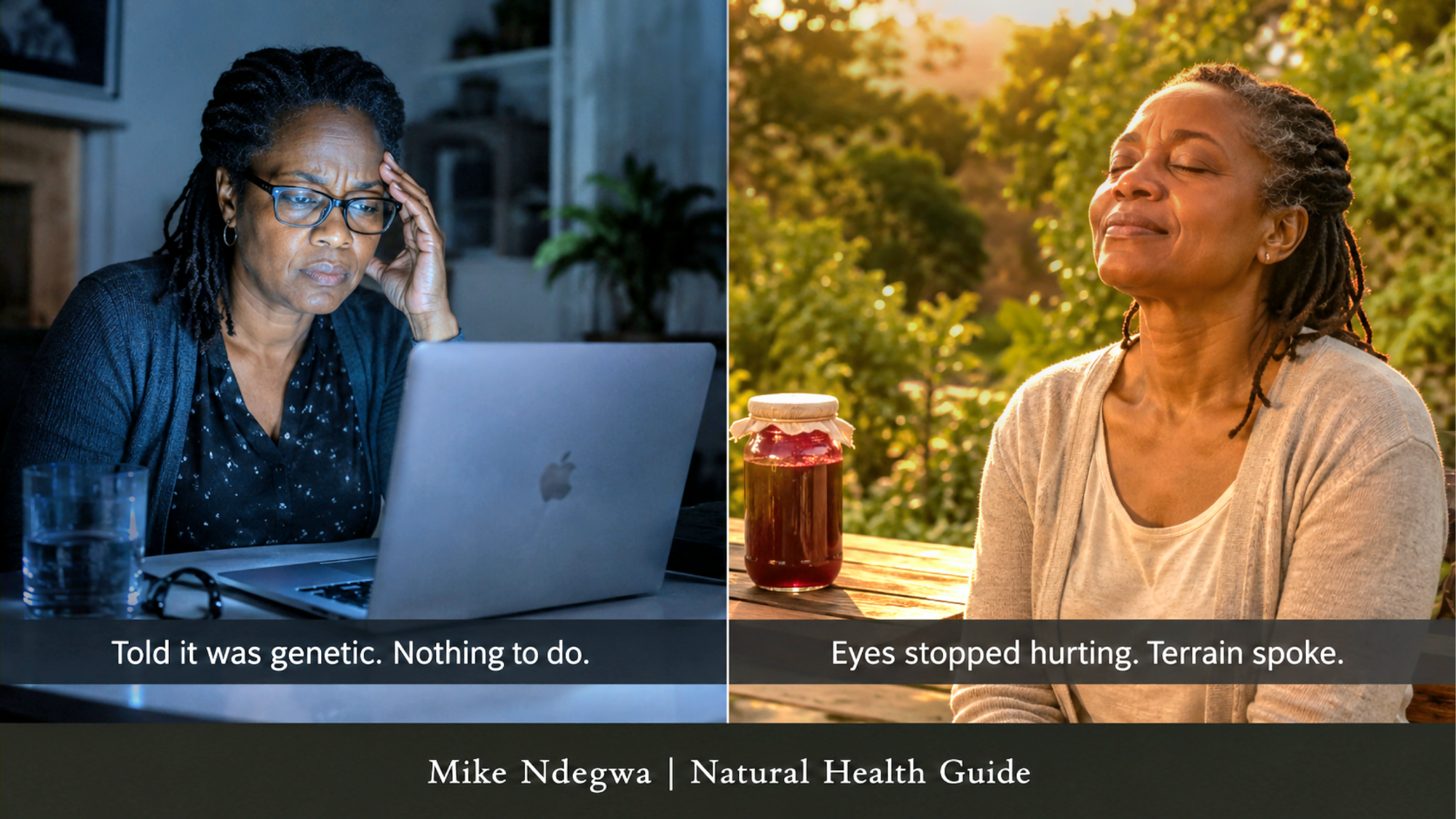
And she had worn glasses since she was twenty-five.
Short-sightedness. Myopia. Every optician she had seen said the same thing: genetic, structural, permanent. The prescription had crept up over the years. She managed it. She accepted it the way people accept things they have been told clearly and repeatedly are beyond changing.
Then she saw a Facebook post and sent a message asking whether it was true that eyes could heal.
What the Eye Tests Were Not Measuring
Nafula’s eye tests had always come back showing a structurally healthy eye. No disease, no damage, no pathology. The lenses and retinas were intact. The pressure was normal. The only finding was the refractive error itself: the eyeball elongated enough that light focused in front of the retina rather than on it, producing the blurred distance vision that glasses correct.
What the eye tests did not measure was the blood supply and nerve supply reaching the eye.
The retina has the highest oxygen consumption per unit weight of any tissue in the human body. It is fed by two separate circulatory systems: the central retinal artery, which supplies the inner layers of the retina, and the ciliary arteries, which supply the choroid and outer retinal layers. Both are small-calibre vessels that are exquisitely sensitive to changes in systemic circulation. When blood flow to these vessels is reduced, even modestly, retinal metabolic function is compromised and the tissues that maintain the eye’s structural health receive less of what they need to regulate normal growth and adaptation.
The ciliary muscle, which controls the lens’s ability to adjust focus between near and distant objects, is innervated by the ciliary ganglion, a branch of the parasympathetic nervous system. When the autonomic nervous system is chronically skewed toward sympathetic activation, which is the state produced by sustained cortisol elevation, the ciliary muscle operates under increased tension. That tension manifests as eye strain, light sensitivity, and the sensation of pressure in the eye even when structural tests show no pathology.
Nafula’s light sensitivity and eye strain under sun exposure and screen use were not symptoms her eye tests could capture. They were symptoms of a nervous system and circulatory system that were being asked to maintain ocular function under conditions of chronic hormonal load. The glasses addressed the refractive error. They did not address why the eye terrain was struggling.
The Cortisol-Thyroid-Vision Axis
Nafula had named something important in her intake without having a framework to understand it fully. She knew her cortisol rose before her period. She knew this affected her thyroid. She knew it disrupted her sleep for two days before each cycle. She had been managing these events as separate occurrences for years.
They were not separate.
Cortisol in chronic elevation suppresses the conversion of T4, the inactive thyroid hormone, to T3, the active form that drives cellular metabolism across the body. Reduced T3 means reduced metabolic rate in every tissue that depends on thyroid signalling for its energy production, and the cells of the ciliary muscle, the lens epithelium, and the retinal ganglion cells are among those tissues. When thyroid function slows, these cells produce ATP less efficiently, their repair processes slow, and the optical system they support becomes less precise and more susceptible to strain.
This monthly cycle of cortisol elevation before Nafula’s period was therefore also a monthly cycle of temporary thyroid suppression, and a temporary reduction in the metabolic support reaching her eyes. Over twenty years, this recurring pattern had accumulated as the baseline of her eye terrain.
Her borderline blood sugar reading, described by her doctor as normal but worth watching, added another layer. Fluctuating blood glucose affects the lens directly: the lens contains a sorbitol pathway that accumulates polyols when glucose is elevated, increasing osmotic stress on lens fibres. Even borderline elevations over years can subtly affect lens clarity and accommodation. This was not a diabetic complication. It was a subclinical metabolic contribution to an eye system that was carrying more load than her tests were designed to reveal.
Phase 1: The Six Weeks That Changed the Baseline
Because Nafula’s diet and lifestyle were already well above average, the Phase 1 work did not need to start from scratch. It needed to be targeted: close the specific gaps that were directly affecting the optic terrain.
The gaps were three. First, she was skipping lunch entirely and extending her fast through midday. For someone whose cortisol already spiked hormonally, a prolonged daily fast added a blood sugar variable the adrenals were compensating for through cortisol release in the early afternoon, precisely the time her daily walk was intended to moderate. Moving to a small light midday meal stabilised this variable.
Second, her dinner was structured correctly in food quality but later in timing than optic nerve repair requires. The eye’s tissues undergo significant repair and metabolic clearing during deep sleep. That process requires the liver to have completed its primary digestive work so it can shift to systemic detoxification and anti-inflammatory support. A later dinner pushed the start of that window later into the night.
Third, the specific micronutrients supporting retinal vasculature and optic nerve myelination, particularly the carotenoids in coloured vegetables, the nitric oxide precursors in beetroot and dark leafy greens, and the omega-3 fatty acids needed for retinal cell membrane integrity, were present in her diet but not in the concentrations or combinations that specifically target ocular circulation.
Two weeks into the plan, Nafula sent one sentence: “The goodness I feel right now is indescribable.”
By week six, she reported what she had come for, and more than she had expected. Her eyes had stopped paining and feeling strained. Sleep had improved dramatically. She was ready for Phase 2.
The Discovery She Made Herself
Phase 2 introduced carrot seed oil as an external support for periorbital circulation, applied at night. Nafula followed the protocol and within a few evenings noticed something precise: on the nights she used the carrot oil before bed, her sleep was lighter and less restorative. She reported this observation carefully, asking whether it was the oil.
It was.
Carrot seed oil contains volatile compounds, including phellandrene and carotol, that increase microcirculation in the periorbital tissue. That increase in local blood flow produces a mild stimulating effect through sympathetic nervous system activation, which in a person with a sensitised nervous system was enough to shift the sleep state away from deep repair toward lighter, more active processing. The effect was subtle but Nafula’s system, already healing and therefore more sensitive to inputs, registered it clearly.
She switched to castor oil at night on her own initiative before the correction was given. Castor oil’s primary constituent is ricinoleic acid, a monounsaturated fatty acid with anti-inflammatory and emollient properties that promotes a grounding, parasympathetic response. Her sleep returned to depth within two nights.
This moment is worth naming precisely. The ability to identify a specific input, connect it to a specific output, and act on the observation without waiting for instruction is not something that can be given through a plan document. It is developed through months of paying close attention to a body that has become responsive enough to signal clearly. Nafula had been building that capacity since September. By November it was working fluently.
January 2026: What She Wrote
On the thirtieth of January, after the new year break, Nafula checked in with four months of progress to report.
“I can’t tell you how happy I am that my eyes don’t pain and my sleep is deeper and restful.”
The eye pain had not returned. Sleep that had been disturbed by hormonal cycles and cortisol spikes was now consistently deep and restorative. She had completed her January fast and was asking what the next phase should be.
The January fast she mentioned in passing is significant context. She had maintained her terrain through a fasting period without losing the gains of the previous four months. The foundational work had become integrated enough to persist through a dietary interruption. That is the difference between a temporary protocol and a genuine terrain shift.
Phase 3: When the Terrain Speaks Through Difficulty
Phase 3 was a structured transition: systematic reintroduction of foods that had been paused across Phases 1 and 2, starting with the proteins that had been limited to support hepatic blood flow to the eyes. Red meat was the first major reintroduction.
Three weeks in, Nafula sent a message in a different register from anything she had sent before. She used the Swahili phrase for a situation that had become genuinely difficult. Sleep was disrupted. She was not falling asleep naturally. Fatigue and brain fog had returned. It had coincided with her period week, which compounded everything.
She asked the question that any honest person in this situation would ask: had her terrain weakened? Was her body telling her the previous phases had not worked?
The answer was the opposite.
Red meat carries a higher metabolic load than the light proteins, fish, chicken, and eggs, that had anchored the previous months. It contains more purines, which generate uric acid in their catabolism. It requires more hepatic processing of haem iron and animal-based saturated fats. It produces more metabolic heat through its specific dynamic action, the energy cost of digestion. When reintroduced into a system that has been running cleanly on lighter inputs, that metabolic load creates exactly the symptoms Nafula experienced: disrupted sleep, because the liver is more active overnight processing the heavier protein load; fatigue, because energy is diverted to digestive work; brain fog, because the liver’s detoxification function, responsible for clearing inflammatory mediators from systemic circulation, is occupied with the food processing queue.
And her period week had arrived simultaneously, a time when progesterone drops, oestrogen fluctuates, and the liver is already handling a higher hormonal clearance load than at other points in the cycle.
This was not a failure of terrain. It was terrain doing what healed terrain does: communicating precisely, immediately, and without ambiguity when an input exceeds its current capacity. A body that was still inflamed and congested would not produce a clear signal from red meat reintroduction. It would simply continue suffering without a distinguishable change. The clarity of the signal was evidence of the healing, not evidence against it.
Red meat was paused. Phase 2 foods were restored. Sleep returned within seventy-two hours. Her eyes remained pain-free throughout.
What This Case Actually Demonstrates
Nafula arrived with a condition she had been told was genetic and permanent, managed by a piece of corrective plastic in front of her eyes, unchanged since her twenties. She left knowing something different, not through a cure, but through an understanding of what her eyes were carrying that no optician had ever asked about.
Myopia as a structural finding may indeed have a genetic component. But the eye strain, the light sensitivity, the pain, the chronic strain under screen use and sunlight, these are not genetic. They are terrain signals. They reflect the quality of blood supply and nerve supply reaching the ocular tissue. They reflect the cortisol-thyroid axis that was cycling monthly through her system and landing in her eyes. They reflect the metabolic support that her retinal cells were and were not receiving based on what she ate, when she ate it, and what her liver was being asked to do overnight while those cells should have been repairing.
She already knew more about her own body than most people in her situation. The gap was not knowledge in the abstract. It was the specific terrain knowledge of what her eyes needed that differed from what her generally well-constructed diet and lifestyle were providing. Closing that gap took six weeks for the pain and strain to resolve and four months for the sleep architecture that supports overnight ocular repair to stabilise.
The carrot oil discovery in November tells the most important part of the story. It is not about the oil. It is about a person who had developed, through sustained and structured attention to her own body’s responses, the capacity to notice a signal she had not been told to look for and act on it correctly before the practitioner had named it. That capacity does not exist at the beginning of terrain work. It is built through it. When it arrives, it is more valuable than any plan document, because it does not expire when the programme ends.
Her eyes are pain-free. Her sleep is deep. The terrain she has built has proven itself precise enough to tell her, clearly and immediately, when she introduced something it was not yet ready for. That is not a terrain that has failed. That is a terrain that has learned to speak.
If you have been told that your vision problem is genetic, or that the eye strain and light sensitivity you live with daily are simply something to manage, the conversation starts with understanding your terrain. Reach out here to begin a free intake assessment.
Mike Ndegwa | Natural Health Guide